A World Apart & Part of the World examines the interplay between the intimate world of an isolated North Coast canyon and the larger outside world.
This theme is explored through the experiences of the book’s characters: a Native Pomo who inherited the traditional role of singing doctor, and another who lobbied Congress to honor the government’s 1851 peace treaty; the homesteaders who settled the lake at the head of the canyon in 1874—one who sold out to Eastern capitalists, the other who ... view more »
A World Apart & Part of the World examines the interplay between the intimate world of an isolated North Coast canyon and the larger outside world.
This theme is explored through the experiences of the book’s characters: a Native Pomo who inherited the traditional role of singing doctor, and another who lobbied Congress to honor the government’s 1851 peace treaty; the homesteaders who settled the lake at the head of the canyon in 1874—one who sold out to Eastern capitalists, the other who refused; the engineer who ran the canyon mill, logging its old growth redwood in the 19th century and the women whose ongoing 20th century efforts saved the last of the canyon’s original redwoods and Douglas fir.
Article by Roberta Werdinger
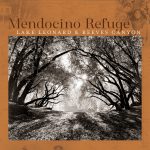
On Saturday, June 15, from 2 to 3:15 p.m., historian Dot Brovarney will give a lecture and presentation on her latest book, Mendocino Refuge: Lake Leonard & Reeves Canyon (2022), at the Grace Hudson Museum. The talk is titled “A World Apart and Part of the World” and is included with Museum admission.
Once upon a time, a still lake formed in the middle of a deep woods. This transformation from what was once a creek occurred because of what is known as the Franciscan Mélange, a unique geology found on the San Francisco Peninsula and in the California Coast Ranges. It consists of basalt, chert, sandstone, and other rocks that were sucked into the earth during subduction, ground down, and then faulted back to the surface. This unstable combination, likened by one commentator to “melted Rocky Road ice cream,” is liable to massive slides. One of these slides formed a basin into which rushed the waters of what, after generations of care by Native Pomo peoples, is now known as Leonard Lake.
Dot Brovarney, a former Grace Hudson Museum curator and the proprietor of Landcestry, first got interested in the lake when she saw a picture of Grace Hudson rowing across a body of water that Dot thought was in the Sierras. It turned out Grace was boating on Leonard Lake, which was named after her great-uncle, John Leonard. Leonard had staked a claim there in 1874 and ran it as a hunting lodge. Situated just a few miles northwest of Ukiah proper, the lake and its property is only reached by Reeves Canyon Road below the Ridgewood Grade. This ten-mile, largely unpaved, and undeniably rough road has challenged generations of visitors. Nevertheless, the beauty of the lake, ringed by old growth redwoods and fir, has long drawn attention.
Brovarney will discuss relationships between canyon dwellers and the larger world beyond the woods in her presentation. She titled it “A World Apart and Part of the World” as it reflects the contrasts and connections between “this separate and wild existence” and the larger American settlement story–a story of struggles that forged California’s sensibilities and reveals its contradictions.
One could say that Lake Leonard, as an entity, and its immediate surroundings dodged a bullet. John Leonard sold the property to a mining and timber interest funded by a group of Boston businessmen. The company’s plan to tunnel through ridges to transport cut logs by flume “would have destroyed at least three watersheds,” in Brovarney’s estimation. In the end, the company couldn’t raise the money to complete the project, leaving the lake and its surroundings relatively untouched.
In 1885, Edith Boyle and her husband purchased the lake property from the company’s major stockholder. Edith, the family matriarch, treasured the old growth redwoods and would never cut them down, even when the family needed money. Edith’s daughter, Una, honored these values, making her home at the lake in the early 20th century. Brovarney, who found Una’s letters dating from 1917-1949, describes Una as “a bit of a rebel.” She came into adulthood during California’s campaign for the woman’s vote and chose to live an unusual, mostly single, and independent life in the woods.
Following Una’s death, her sister and brother sought buyers who would preserve nature. That is how Richard and Susanna Dakin became the new proprietors, in 1953. The legacy of conservation of the land continued, as did the tradition of strong-minded and independent females. During the period of heavy logging that followed World War II, Susanna confronted a logger who was standing in front of a redwood on nearby property, chainsaw in hand. “You can’t cut that tree; it is on my property,” Susanna insisted. The next day, as the family story goes, she drove into town and bought the land.
The next generation of care was passed to Susanna and Richard’s three children–Sue, Henry, and Mira, who carried forward their parents’ commitment, which has been carried forth by their descendants in turn. In 1998, they placed a conservation easement on over 3800 acres, three miles of which adjoin Montgomery Woods. The family decided to rent the property as a resort to create income that support conservation management of the land. It has become a popular wedding and vacation destination.
Brovarney herself has carved out an interesting niche for herself, as an independent historian of Ukiah Valley and greater Mendocino County. “What really gets my adrenaline going is solving a mystery,” she admits, speaking of the process that inspires her writing. Having heard from people who were turned off by theteaching of history in school, she wants to present a way that is more relatable. “I take the reader on my journey,” she says, “following the clues along with me.” Research, too, is a journey for Brovarney, who has curated exhibits on the basket collection of Elsie Allen and on the shipwreck of the Frolic off the coast in 1850. “Even this isolated place we live in,” Brovarney concludes, “nonetheless remains connected to larger historical events in the world.”
The Grace Hudson Museum is at 431 S. Main St. in Ukiah. General admission is $5; $12 per family; $4 for students and seniors; free to all on the first Friday of the month; and always free to members, Native Americans, and standing military personnel. For more information please go to www.gracehudsonmuseum.org or call (707) 467-2836. The website for Mendocino Refuge is https://www.mendocinorefuge.com/.
View less